
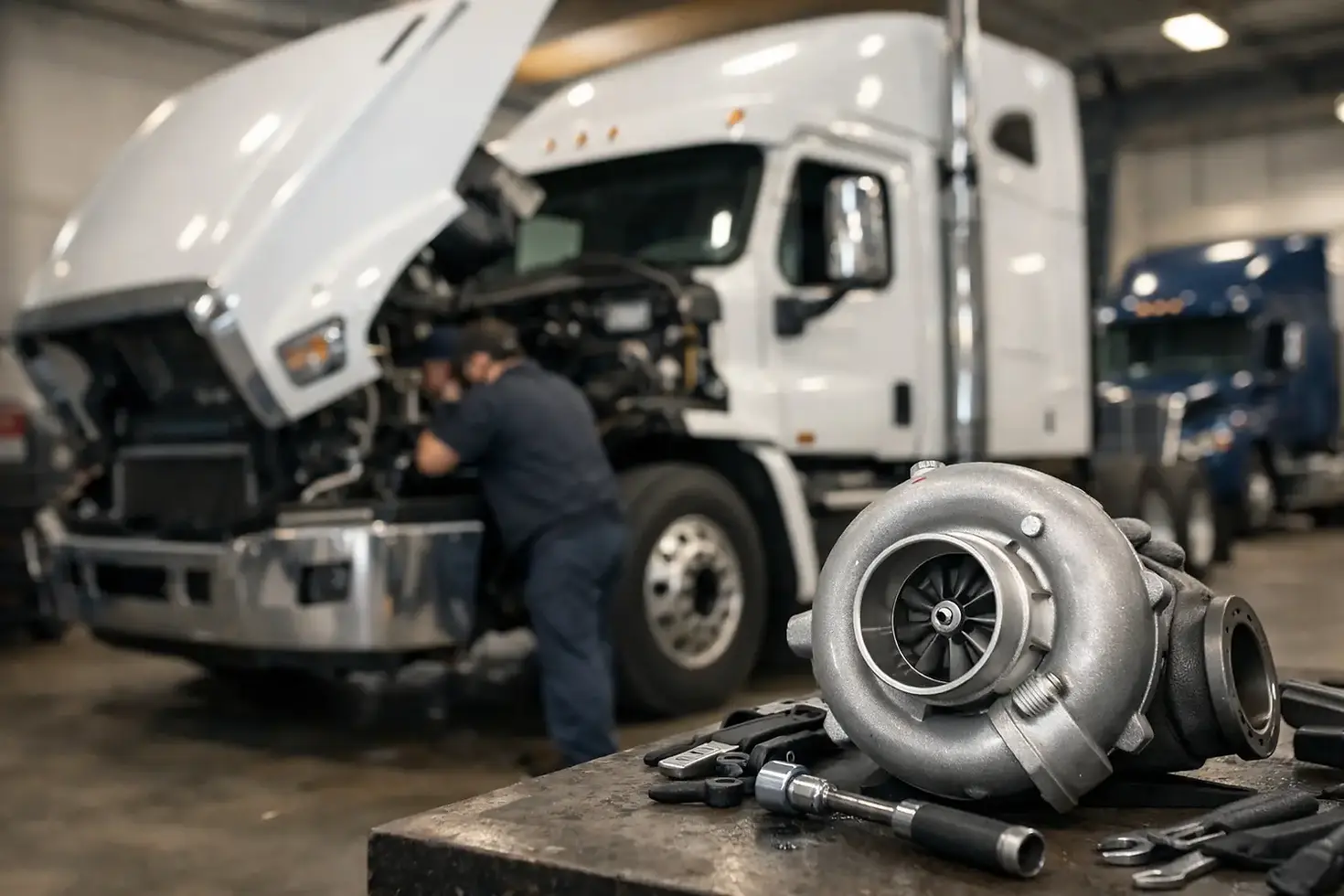
Commercial Truck Turbo Repair BC
A truck that still starts, idles, and moves can still be headed for a turbo failure that takes it off the road at the worst possible time. In commercial truck turbo repair BC, the real job is not just replacing a failed unit. It is finding out why boost dropped, why exhaust temperatures changed, why oil got where it should not, and whether the turbo is the root problem or the result of something else in the engine system.
For fleets, owner-operators, and diesel technicians, that distinction matters. A turbocharger is not an isolated bolt-on part. It lives in the middle of oil supply, air intake, exhaust flow, fueling, emissions hardware, and driver load demand. If diagnosis stops at the compressor housing, the same truck can be back with the same complaint in short order.
What commercial truck turbo repair in BC really involves
A proper turbo repair starts with symptom verification, not assumptions. Low power, excess smoke, overboost, underboost, whistling, oil consumption, and active fault codes can all point toward the turbocharger, but they can also come from charge air leaks, injector imbalance, exhaust restrictions, actuator faults, or poor oil control.
That is why commercial truck turbo repair in BC should include more than removing the turbo and checking shaft play. On a heavy-duty diesel platform, the process often involves inspection of the compressor and turbine wheels, bearing condition, housing damage, vane movement on variable geometry systems, actuator operation, oil feed and drain condition, CAC system pressure integrity, and supporting fuel and air data. If any one of those areas is missed, the repair can be incomplete.
This is especially true on modern engines running tighter emissions strategies. A sticking VGT mechanism, failed electronic actuator, or excessive soot loading can change boost behavior in ways that look like a worn turbo. In other cases, the turbo is damaged because of upstream or downstream issues such as poor air filtration, oil contamination, restricted DPF flow, or injector overfueling.
Common signs your truck may need turbo service
The most obvious complaint is loss of power under load, especially on grades or when pulling weight. Drivers may also notice slow spool-up, surging boost, black smoke, blue smoke, a high-pitched whistle, or an engine that feels flat even though no hard mechanical noise is present.
Oil around the compressor outlet or charge pipes is another warning sign, but it needs context. A light oil film does not always mean the turbocharger has failed. Excessive oil, however, especially when paired with smoke or rising oil consumption, calls for a closer look at seals, bearing wear, crankcase pressure, and drain line function.
Check engine lights and boost-related fault codes matter too, but they are not a diagnosis by themselves. Fault codes tell you what the ECM is seeing, not always what caused it. A truck can log underboost because of a cracked charge air cooler hose just as easily as from internal turbo damage.
Why truck turbos fail
Most turbo failures come from contamination, lubrication problems, heat stress, overspeed, or a related engine fault that was left unresolved. Bearing systems depend on clean oil at the right pressure and flow. If the feed line is restricted, the drain is slow, or the oil is contaminated, the center housing does not survive long.
Foreign object damage is another common cause. Dirt entering through the intake side can damage the compressor wheel, while broken exhaust-side material can damage the turbine. Once wheel edges are chipped or housings are scored, efficiency drops fast and imbalance can follow.
Heat is a major factor in commercial applications. Repeated shutdown after heavy load, exhaust restriction, fueling issues, and prolonged high EGT operation can all shorten turbo life. Variable geometry units are especially sensitive to soot and heat-related sticking. The result may be poor vane response, actuator strain, and unstable boost control.
There is also the rebuild-versus-replace question. It depends on the condition of the housings, rotating assembly, shaft, wheels, and actuator system. Some units are excellent rebuild candidates. Others have damage that makes replacement the more reliable option. The right answer comes from inspection and measurement, not from guessing based on mileage alone.
The value of bench testing and component-level inspection
A commercial truck turbo is too expensive and too critical to treat as a trial-and-error part. Component-level inspection matters because heavy-duty applications run under sustained load, and marginal parts do not stay marginal for long.
Bench testing, calibration checks where applicable, and close inspection of actuator performance help separate a mechanical turbo failure from a control issue. This is one reason specialist diesel shops are often the better choice for commercial units. The work requires familiarity with OEM turbo designs, rotating assembly tolerances, vane systems, and the fuel and air systems that influence turbo performance.
For operators running Cummins, Caterpillar, Volvo, and other major diesel platforms, brand-specific knowledge matters. The failure pattern on one application may not match another, even when the symptom looks the same from the cab. An experienced shop will know where those patterns tend to show up and what supporting systems need to be checked before the truck goes back to work.
Repair, rebuild, or replace
There is no one-size-fits-all answer here. If the housings are sound, the wheels are serviceable, and the center section can be restored to proper specification, a rebuild can be a cost-effective and dependable repair. If there is major wheel damage, severe housing contact, actuator failure beyond practical repair, or contamination that has spread through multiple systems, replacement may be the better route.
The key is quality control. A rebuild only makes sense when it is done with proper parts, machining standards, balancing, and final inspection. Cheap rebuilds tend to fail for the same reason cheap replacements do - they do not correct the underlying issue, and they often do not meet the tolerances required for heavy-duty service.
This is where a one-stop diesel component shop has a real advantage. If turbo trouble is tied to fueling, injector performance, oil contamination, or another related diesel system issue, it is more efficient to have the diagnosis handled in the same technical environment. West Coast Fuel Injection & Turbo Ltd. works in that space every day, where turbocharger service is connected to the larger engine system rather than treated as an isolated parts swap.
Downtime costs more than the turbo
For a commercial truck, the biggest expense is often not the component itself. It is the missed load, the idle equipment, the service interruption, and the second repair if the first one was incomplete. That is why experienced fleet managers usually want root-cause diagnosis before authorizing parts.
A truck that eats a turbo because of restricted oil supply will do it again. A truck with boost complaints caused by a split CAC boot does not need a turbocharger at all. A truck with repeated vane issues may have an exhaust or emissions condition that needs to be dealt with before another actuator is installed. Good repair work protects uptime because it narrows the problem correctly the first time.
In BC, this matters even more for trucks working mixed conditions - highway miles, mountain grades, port traffic, municipal routes, construction access, and seasonal temperature swings. Turbo systems see very different stresses depending on how the truck is used. A linehaul tractor, a vocational unit, and a marine or industrial diesel package may all use turbochargers, but the duty cycle changes what failure looks like and what repair strategy makes sense.
Choosing a shop for commercial truck turbo repair BC
The best shop is not necessarily the one that promises the fastest swap. It is the one that can verify the failure, inspect related systems, source the right OEM or equivalent-quality components, and support rebuild or replacement work with real testing and diesel-specific experience.
Ask whether the shop handles diagnostics in-house, whether it works with major diesel brands, whether it can inspect actuator and control issues, and whether it understands the connection between turbo performance, injectors, pumps, emissions equipment, and oil condition. For fleets and independent operators alike, that broader capability reduces guesswork.
It also helps to work with a shop that understands the practical side of service. Not every truck needs the most expensive path. Not every damaged unit should be rebuilt. Not every low-boost complaint is a turbo. The right recommendation is the one that fits the actual condition of the truck, the workload it has to return to, and the cost of getting it wrong.
If your truck is showing early turbo symptoms, the smart move is to address it before a minor performance issue becomes a hard failure with collateral damage. Good turbo repair is less about replacing parts and more about restoring the engine system to the condition it needs for reliable work.
Comments