
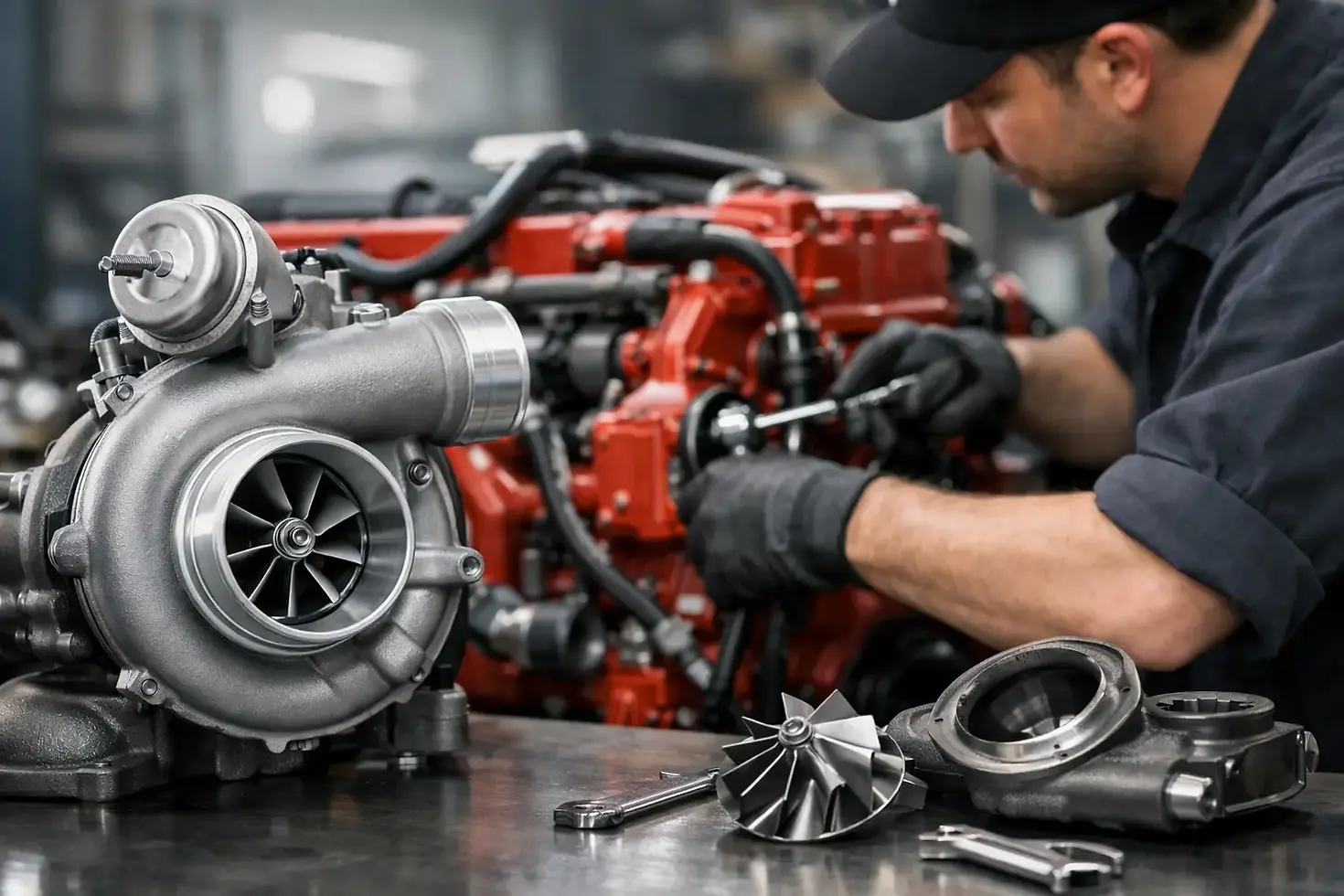
Cummins Turbo Problems, Repair, and Upgrade
- Jul 12
- 6 min read
A Cummins turbo usually gets attention only after the truck starts feeling lazy, boost drops off, or exhaust temperatures begin climbing under load. By that point, the problem is often bigger than "the turbo is bad." On a diesel platform, turbocharger condition is tied directly to fueling, air flow, oil quality, exhaust heat, and how the engine is actually being worked.
That matters whether you are running a light-duty pickup, a vocational truck, farm equipment, industrial machinery, or a marine application built around Cummins power. A turbocharger can fail on its own, but just as often it is reacting to another issue upstream or downstream. If you replace the unit without addressing the cause, the next failure may come quickly.
What a Cummins turbo is really dealing with
A turbocharger lives in a hard environment. It is exposed to very high exhaust temperatures, rapid shaft speeds, heavy load changes, and constant oil dependence. On many Cummins engines, especially in working applications, the turbo is expected to build boost consistently through towing, hauling, stop-and-go operation, idling, and extended high-load use.
That operating pattern matters. A highway truck that runs hot and steady is hard on parts in one way. A service truck or agricultural machine that idles, accelerates hard, and sees frequent thermal cycling is hard on them in another. The same applies to marine and industrial engines where load can stay high for long periods. There is no single failure pattern that covers every Cummins turbo.
Common Cummins turbo failure symptoms
The obvious complaint is loss of power. The engine may feel flat on acceleration, struggle to build boost, or fall off badly under load. In some cases the driver notices excessive smoke first. Black smoke points toward poor air supply or inefficient boost. Blue smoke can suggest oil passing through the turbo, though engine wear and crankcase ventilation problems can create similar symptoms.
Whining, scraping, or siren-type noises also deserve attention. Some turbo noise is normal, especially on certain setups, but a sudden change is not. A damaged compressor wheel, shaft play, bearing wear, or housing contact can all create noise before total failure.
Then there are the less obvious signs. High exhaust gas temperature, repeated derate conditions, poor fuel economy, oil consumption, charge-air system contamination, and fault codes related to boost or actuator performance can all point back to the turbo system. On electronically controlled applications, the problem may involve the actuator, vane mechanism, or calibration rather than the rotating assembly alone.
Why Cummins turbochargers fail
Oil-related failure stays near the top of the list. A turbocharger depends on clean oil at the correct pressure and flow. Restricted supply lines, contaminated oil, poor maintenance intervals, drain restrictions, or shutdown habits after severe load can all shorten bearing life. Once lubrication is compromised, shaft movement increases and wheel damage often follows.
Contamination is another major cause. Dirt entering through the intake side can damage the compressor wheel. Debris from the engine side can damage the turbine. Even small foreign material can upset balance at turbo shaft speeds. A damaged air filter, leaking intake plumbing, failed engine component, or deteriorating charge-air hose should never be ignored during diagnosis.
Heat and overspeed are also common contributors. If the engine is overfueling, if the charge-air cooler is restricted, if there is an exhaust restriction, or if the control side of the turbo is not functioning correctly, shaft speed and heat can rise beyond what the unit should be seeing. Variable geometry turbochargers add another layer because soot buildup, vane sticking, and actuator issues can push the assembly outside normal operating range.
Cummins turbo diagnosis should not stop at boost numbers
A boost reading alone does not tell the whole story. You can have low boost because the turbo is worn, but you can also have low boost because of boost leaks, fueling imbalance, actuator problems, exhaust leaks, restricted air flow, or engine condition issues. Swapping parts before testing usually costs more time and money in the end.
Proper diagnosis starts with the basics - visual inspection, intake and charge-air system checks, oil supply and drain inspection, shaft movement evaluation, and signs of wheel contact or housing damage. From there, engine-specific testing matters. On electronically controlled systems, scan data, actuator response, vane movement, fault history, and commanded versus actual boost all help narrow the problem.
This is where a dedicated diesel shop has an advantage. The turbocharger should be treated as part of a working air and fuel system, not as an isolated bolt-on part. If fueling is off, if injectors are not atomizing correctly, or if the high-pressure fuel side has another issue, the turbo may be compensating for a problem it did not create.
Repair, rebuild, or replace?
It depends on the turbo model, the extent of damage, and the application. Not every failed turbo should be replaced with a new complete unit, and not every turbo is a good rebuild candidate. A proper evaluation looks at housing condition, wheel damage, shaft and bearing wear, actuator condition, vane assembly wear on VGT models, and whether the core parts remain usable within specification.
A rebuild can be the right move when the main hard parts are sound and the unit can be restored using quality components, correct balancing, and proper calibration where required. This is especially true when the objective is to return a work truck or equipment engine to dependable OEM-level operation rather than chase an unnecessary aftermarket setup.
Replacement makes more sense when the housings are damaged, contamination has caused major wheel contact, the actuator has failed beyond economic repair, or prior failure sent debris through the assembly. There are also cases where repeated issues on a heavily worked application justify stepping back and reviewing the full system, including whether the existing turbo specification still matches the job.
The role of VGT systems in newer Cummins applications
Many later Cummins engines use variable geometry turbochargers, and these bring clear performance and drivability benefits. They improve low-speed response, help with emissions strategies, and can support exhaust braking functions. The trade-off is complexity.
When a VGT unit develops soot-related sticking, actuator failure, or vane ring wear, the symptoms can look inconsistent. The truck may pull well one day and feel weak the next. It may set intermittent codes, surge, overboost, or lag badly off idle. A quick visual check is rarely enough.
These systems need proper bench evaluation and informed troubleshooting. Replacing an actuator without checking the mechanical side, or replacing the turbo without checking control strategy and engine condition, can leave the root cause in place.
Upgrades are not always the answer
There is a place for a performance-oriented Cummins turbo upgrade, but it needs to match the use case. More air potential sounds appealing, yet a larger or different turbo may hurt low-speed response, towing behavior, exhaust brake performance, or overall drivability if the rest of the setup is not built around it.
For work applications, reliability usually matters more than peak numbers. Fleet operators, owner-operators, and equipment managers often benefit more from a properly matched OEM or equivalent remanufactured unit than from a performance change that shifts the power band. If the truck is towing, hauling, or running predictable duty cycles, the best turbo is generally the one that supports stable EGT control, clean boost response, and long service life.
Why system-level service matters
Turbocharger problems are rarely just turbocharger problems. Charge-air leaks, injector issues, fuel delivery faults, restricted DPF or exhaust flow, crankcase pressure problems, and oil contamination can all show up as poor turbo performance. Treating each symptom separately creates repeat downtime.
That is why many diesel owners and fleets prefer a shop that can inspect the complete system in one place. At West Coast Fuel Injection & Turbo Ltd., that matters because turbocharger work often overlaps with injector testing, fuel system diagnosis, calibration, and installation support. For customers in working markets such as Richmond, Vancouver, Surrey, Abbotsford, and Vancouver Island, reducing diagnostic handoffs can save both labor time and equipment availability.
What to check before installing any repaired or replacement turbo
Installation quality decides a lot of outcomes. The oil feed and drain path should be clean and confirmed. Intake piping and the charge-air cooler need inspection for contamination and debris. Air filtration and hose condition should be verified. On an engine that had a hard turbo failure, cleaning the system is not optional.
Control-side checks matter too. If the application uses an actuator or variable geometry system, setup and verification are part of the job. The same goes for checking fault codes, boost leaks, and engine operating condition after installation. A new or remanufactured turbo cannot compensate for an unresolved fueling or air management problem.
If your Cummins turbo is showing early warning signs, the smart move is to test the full system before the failure turns into a roadside problem or a larger engine repair. Catching bearing wear, vane issues, oil supply trouble, or charge-air leaks early is usually far less expensive than dealing with wheel damage, contamination, and downtime after the unit comes apart.
The best turbo repair is the one that solves the cause, not just the symptom.
Comments