
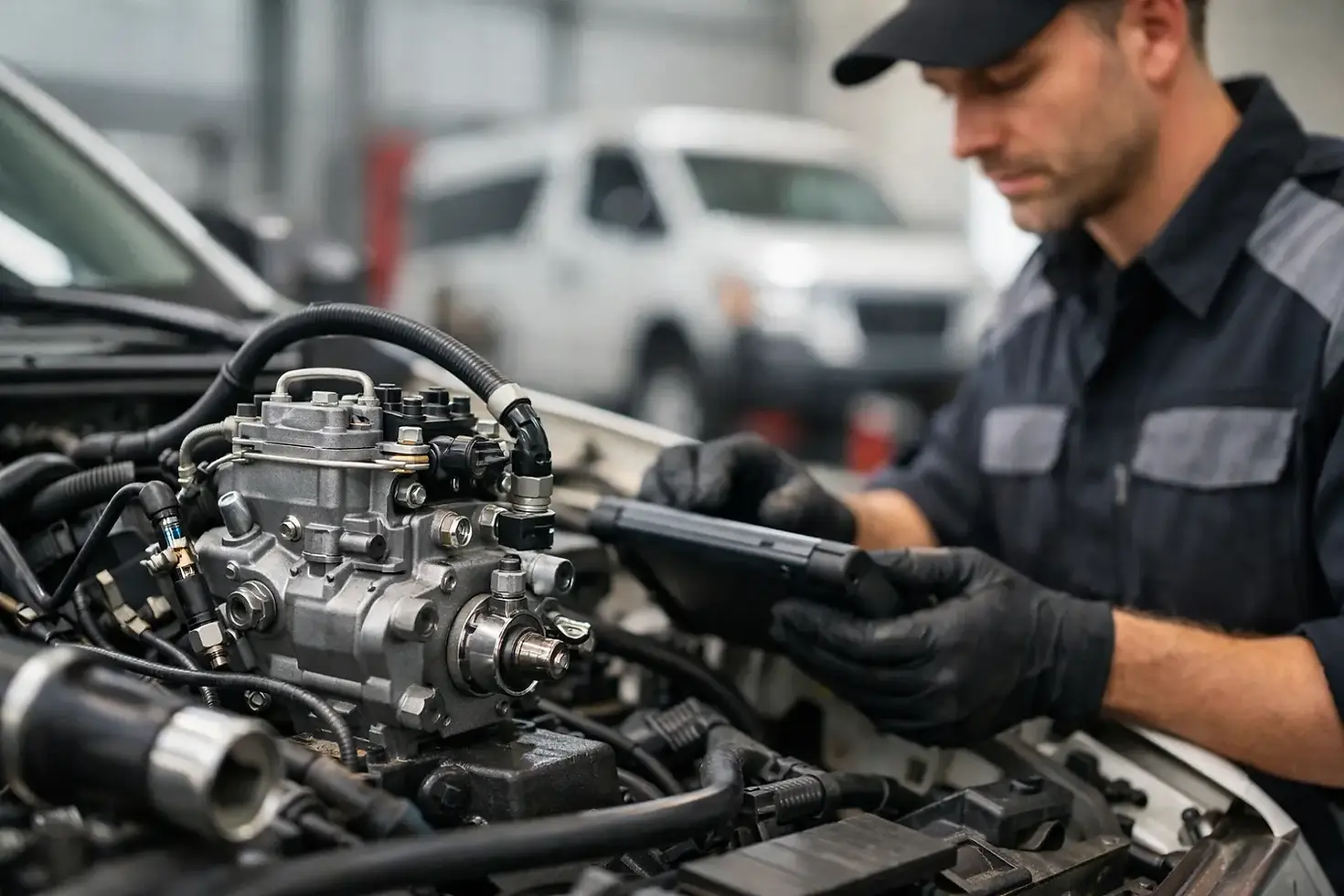
Diesel Fuel Pump Diagnostics BC for Hard Starts
- Jul 20
- 6 min read
A diesel that cranks too long, falls flat under load, surges at steady throttle, or sets low-rail-pressure codes may have a fuel pump problem. But a pump should not be condemned from symptoms alone. Proper diesel fuel pump diagnostics BC work separates an actual pump failure from contaminated fuel, air entering the supply side, restricted filtration, wiring faults, injector return issues, or a control-system problem.
For an owner-operator, fleet manager, equipment mechanic, or marine operator, that distinction matters. Replacing a high-pressure pump without finding the cause can turn one repair into repeat downtime, damaged injectors, and a contaminated fuel system.
Start With the Fuel System, Not the Part Number
The fuel pump is only one part of a system that must deliver clean fuel at the correct volume, pressure, and timing. On older mechanical engines, diagnosis may center on transfer-pump supply, injection-pump timing, governor response, and internal wear. On common-rail systems from Cummins, Caterpillar, Volvo, Bosch, Denso, and other major platforms, the process also involves commanded versus actual rail pressure, metering controls, sensor signals, and fault-code data.
The first question is simple: when does the problem occur? A no-start after sitting overnight points in a different direction than a truck that loses power pulling a grade or an excavator that runs poorly only after reaching operating temperature. A machine that starts normally but lacks power may have a supply restriction, weak lift pump, boost issue, or fuel-pressure limitation. A hard start with white smoke can involve fuel delivery, injector performance, compression, or timing.
A good diagnostic process establishes the operating condition before parts are removed. That prevents a component-level repair from becoming guesswork.
Common Signs of a Fuel Pump Fault
Pump-related failures do not look identical across every application. Heavy-duty trucks, agricultural machines, industrial engines, light-duty pickups, and marine engines each see different duty cycles, fuels, and operating environments. Still, several symptoms deserve immediate attention:
Extended cranking, hard starting, or a crank-no-start condition
Power loss under load, especially during acceleration or uphill pulls
Rough idle, surging, hesitation, or intermittent stalling
Low fuel-rail-pressure or fuel-delivery fault codes
Excessive smoke, poor fuel economy, or reduced throttle response
Metal debris in the fuel filter or fuel-system components
Metal contamination is the most urgent sign. A failing high-pressure pump can release fine metallic particles into the rail, injectors, lines, and tank. Continuing to run the engine can spread damage quickly. The correct repair may require a complete system inspection and cleaning, not just a replacement pump.
Diesel Fuel Pump Diagnostics BC: The Testing Sequence
Accurate diagnosis follows a sequence because each test affects the next. The goal is to verify fuel quality and supply first, then confirm pressure control and pump operation, and finally determine whether the pump can be repaired, rebuilt, or should be replaced.
1. Inspect Fuel Quality, Filters, and the Low-Pressure Supply Side
Before testing a high-pressure pump, inspect the fuel sample for water, sediment, biological growth, gasoline contamination, or signs of poor lubricity. Diesel fuel is also a lubricant for many pump designs. Contaminated or low-lubricity fuel can accelerate internal wear.
Filters must be checked for restriction and correct installation. A collapsed seal, incorrect filter, cracked pickup tube, blocked tank vent, or loose fitting can create symptoms that mimic a failing pump. On the suction side, even a small air leak may not drip fuel externally, but it can allow air into the system and cause hard starts, unstable pressure, or intermittent stalling.
Low-pressure supply volume and pressure should be measured against the engine manufacturer's specifications. A high-pressure pump cannot produce stable rail pressure if the lift pump or supply circuit cannot feed it.
2. Scan Data and Compare Commanded Pressure With Actual Pressure
Electronic diesel systems provide valuable clues when scan data is interpreted correctly. Technicians compare desired rail pressure with actual rail pressure during cranking, idle, acceleration, and loaded operation. They also review relevant fault codes, fuel-temperature readings, pressure-sensor signals, metering-valve duty cycle, and engine speed data.
If commanded pressure rises but actual pressure remains low, the cause may be insufficient pump output, a failing fuel-metering valve, excessive injector return flow, a leaking pressure-relief device, or a supply-side limitation. If the pressure reading is implausible or erratic, the rail-pressure sensor, connector, wiring, or control module may be at fault instead.
This is where diagnosis requires judgment. A low-pressure code does not automatically mean the high-pressure pump has failed.
3. Check Return Flow and Internal Leakage
On common-rail engines, excessive return flow can prevent rail pressure from building, particularly during cranking. Injector leak-off testing helps identify injectors that are bypassing too much fuel internally. Depending on the system, pump-case drain or return volume may also be checked to identify internal pump wear.
A worn pump can lose pressure internally even when it appears to deliver fuel. Conversely, one injector with excessive return flow can create a no-start or low-pressure condition that looks like a pump issue. Testing both sides of the system protects the customer from replacing the wrong component.
4. Verify Electrical Controls Before Removing the Pump
Modern pumps often use electronically controlled fuel-metering valves, suction-control valves, or fuel-control actuators. These components need power, ground, signal integrity, and proper mechanical movement. Damaged harnesses near the engine, corroded connectors, heat-related failures, and poor grounds can create intermittent faults that disappear during a quick visual inspection.
Testing should include circuit checks and, where appropriate, component actuation through the diagnostic tool. A failed metering valve may be serviceable separately on some applications, while others require pump removal and controlled testing. It depends on the pump design, the availability of quality parts, and whether contamination or internal wear has already been found.
5. Bench Test the Removed Fuel Pump
When vehicle or equipment testing points to the pump, bench testing is the decisive step. A properly equipped fuel lab can test delivery volume, pressure capability, calibration points, control-valve performance, internal leakage, and governor or timing function where applicable. Mechanical injection pumps can also be evaluated for timing, rack movement, and delivery balance across cylinders.
Bench testing is especially valuable for pumps used in construction, agricultural, industrial, and marine applications. A machine may have limited onboard diagnostics, yet the injection pump still requires precise calibration to meet its operating requirements. Testing under controlled conditions provides a clearer answer than fitting a replacement component and hoping the symptom is resolved.
Repair, Rebuild, or Replace?
The right answer depends on what testing finds. A pump with a failed external control valve and clean fuel may need a targeted repair. A mechanically worn pump may be a strong candidate for rebuilding or remanufacturing with quality internal parts and calibration. A severely damaged pump that has contaminated the system may require replacement along with cleaning or replacement of affected rails, lines, injectors, filters, and tank components.
Cost matters, but so does the consequence of a repeat failure. For a commercial truck, fishing vessel, farm machine during harvest, or generator supporting a critical operation, the lowest initial repair price can become expensive if the underlying contamination or supply fault remains. The repair scope should match the evidence, the application, and the required level of reliability.
West Coast Fuel Injection & Turbo Ltd. performs component diagnostics, bench testing, calibration, rebuilding, and installation support for diesel pumps, injectors, and turbochargers across demanding diesel applications. For customers in Richmond, Vancouver, the Fraser Valley, Vancouver Island, and throughout British Columbia, having fuel-system testing and component service handled by a specialist can reduce the back-and-forth between multiple repair sources.
Preventing Repeat Pump Failures
Once a fuel pump issue is confirmed, prevention starts before the repaired or replacement component is installed. The fuel tank and supply circuit should be assessed for contamination. Filters should be replaced, and lines, rails, and injectors should be inspected when metal is present. On high-pressure common-rail systems, reusing contaminated components can quickly damage a newly installed pump.
Regular filter service, clean fuel storage practices, prompt water drainage, and attention to low-pressure supply faults all extend pump life. So does avoiding operation with a nearly empty tank when the application is prone to tank sediment or fuel aeration. There is no single maintenance interval that fits every engine, because duty cycle, fuel quality, ambient conditions, and operating hours vary widely.
When a diesel begins to hard-start, lose power, or show fuel-pressure faults, treat it as a system warning rather than a parts-shopping exercise. A measured diagnostic process can identify the actual failure, protect the rest of the fuel system, and get equipment back to dependable work with fewer repeat repairs.
Comments