
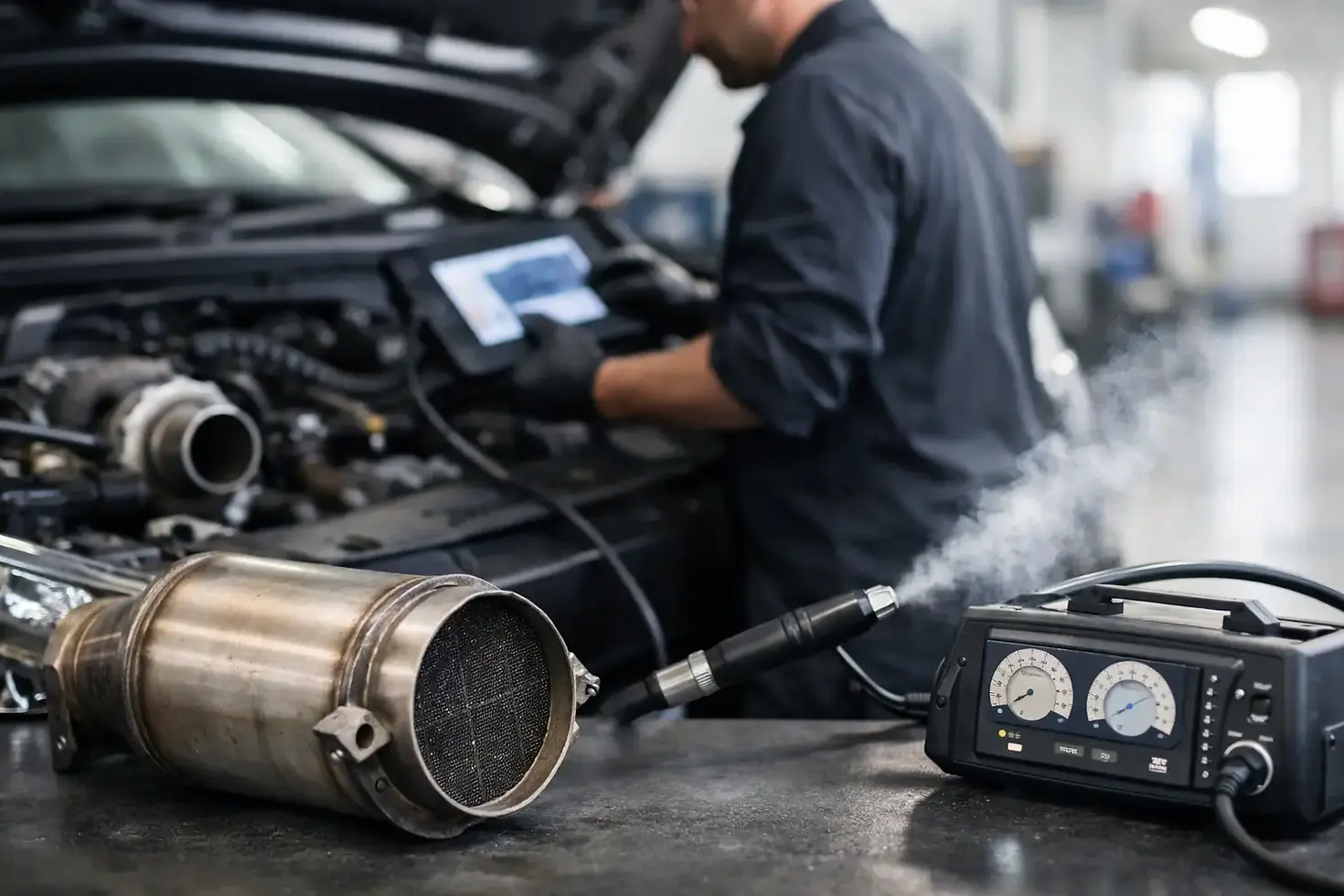
DPF and Emissions Diagnostics Explained
A truck comes in with repeated parked regens, rising fuel use, and a driver complaint that power falls off under load. Another machine shows a DPF warning, but the real problem is a failed differential pressure sensor hose. This is why dpf and emissions diagnostics cannot be treated as a quick code scan. On modern diesel equipment, the fault you see is often the result of a different failure upstream.
For fleet operators, owner-operators, mechanics, and equipment managers, the cost of getting this wrong is more than an annoying dash light. Misdiagnosis leads to unnecessary DPF cleaning, replacement of good parts, repeat downtime, and in some cases turbocharger or fuel system damage that started the emissions problem in the first place. Proper diagnosis means looking at the entire combustion and aftertreatment chain, not just the filter canister.
What dpf and emissions diagnostics actually involve
A proper diagnostic process starts with the system layout on that engine platform. Depending on the application, you may be dealing with a diesel oxidation catalyst, DPF, SCR system, DEF dosing components, EGR components, NOx sensors, temperature sensors, differential pressure sensors, and the engine controls that manage regeneration. Cummins, Caterpillar, Volvo, and other major platforms all use different logic, thresholds, and service procedures.
That matters because a plugged DPF is not always a DPF problem. Excess soot can be caused by poor injector performance, incorrect fuel delivery, restricted air flow, boost leaks, turbo issues, EGR faults, or an engine that is spending too much time in low-load operation. Excess ash loading is different again. Ash does not burn off in regeneration, so a unit can complete regens properly and still reach the point where cleaning is required.
Good emissions diagnostics separate soot loading from ash loading, sensor error from actual restriction, and electronic faults from mechanical causes. Without that distinction, repairs turn into guesswork.
Why code reading alone is not enough
A fault code points you to the circuit or condition the ECM has recognized. It does not guarantee the failed part. If the ECM reports high DPF differential pressure, the problem may be a restricted filter, but it may also be split pressure lines, a biased sensor, exhaust leaks, incorrect sensor scaling, or excessive soot production from poor combustion.
The same applies to regeneration complaints. A truck that cannot complete an active regen may have a bad temperature sensor, an intake issue, low boost, injector imbalance, an EGR valve fault, or operating conditions that never allow exhaust temperature to stay high enough. Replacing the DPF because regen frequency increased is one of the more expensive ways to avoid proper testing.
This is where workshop-level diagnostics make the difference. Live data, commanded tests, pressure readings, thermal behavior, and component inspection all need to agree before a repair decision is made.
The main failure patterns behind DPF problems
Most recurring DPF issues fall into a few categories, but the root cause still varies by application.
The first is excess soot production. When injectors are over-fueling, atomization is poor, timing is off, or air supply is weak, the engine produces more particulate matter than the aftertreatment system can manage efficiently. In heavy-duty trucks and industrial equipment, turbocharger performance is a major part of this. Low boost, vane control issues, charge air leaks, or exhaust-side problems can all raise soot output.
The second is failed regeneration. The DPF may be loadable and cleanable in theory, but the machine never gets the temperature profile needed to burn soot effectively. A temperature sensor reading low, a doser issue, or an engine that idles for long periods can all create the same symptom.
The third is ash accumulation. This is a service-life issue, not a regen issue. Once ash loading reaches a certain point, the filter must be cleaned with the proper process or replaced if it has reached the end of service life. No forced regen will remove ash.
The fourth is sensor and control faults. Differential pressure sensors, NOx sensors, EGT sensors, DEF quality issues, wiring faults, and control logic errors can all trigger warnings or derate conditions even when the DPF substrate itself is still usable.
How a proper diagnostic process works
Effective dpf and emissions diagnostics usually begin with fault history and operating context. Has the unit been idling heavily? Has fuel economy changed? Is there oil consumption, coolant loss, hard starting, low power, or a recent turbo or injector repair? A technician needs the pattern, not just the current code list.
The next step is scan tool analysis with live data. That includes soot load calculations, differential pressure values, exhaust temperature readings, NOx performance where applicable, regen history, and any inhibited conditions. Those numbers need to be read at idle and under operating load where possible. A pressure value that looks acceptable in the bay may be completely wrong on a pull.
After that comes physical inspection and testing. Pressure lines need to be checked for blockage, cracking, or condensation damage. Exhaust leaks ahead of sensors can skew readings. Wiring damage is common on working trucks, agricultural machines, and industrial equipment exposed to heat, vibration, and weather. If there is evidence of poor combustion, the diagnostic path moves upstream into injectors, turbocharger operation, charge air integrity, EGR performance, and fuel supply.
Only then should cleaning, forced regeneration, sensor replacement, or DPF replacement be considered. A forced regen on an engine with a real combustion problem may just accelerate failure.
Upstream engine problems are often the real cause
This is the part many general repair shops miss. The DPF is downstream of the engine, so it records the results of poor combustion. It does not create them.
An injector with poor spray pattern can increase soot load even before drivability complaints become obvious. A high-pressure fuel pump problem can affect delivery quality and combustion stability. Turbocharger faults can reduce air availability and push particulate output up fast, especially under load. EGR issues can also change combustion temperatures and soot formation. On some applications, repeated emissions faults are the first visible sign that the fuel or air system is no longer operating correctly.
That is why businesses with in-house diesel fuel system capability and turbocharger expertise are often better positioned to solve recurring emissions problems. If the shop can bench test injectors, evaluate pump performance, inspect turbocharger condition, and correlate those findings with ECM data, the repair is more likely to fix the whole problem instead of only clearing the warning light.
When cleaning helps and when it does not
DPF cleaning has a place, but only when the filter condition and failure mode support it. If the issue is ash loading and the substrate is intact, proper cleaning can restore function. If the filter has been melted, cracked, oil-soaked, or contaminated by coolant, cleaning may not return it to reliable service.
The same caution applies to repeated off-vehicle cleaning without root cause repair. If an engine is over-fueling or running with poor air supply, the cleaned DPF will simply load up again. That is not a filter problem. That is an unresolved engine problem showing up in the aftertreatment system.
A good shop will also look at service intervals and duty cycle. A truck on highway runs behaves differently from a yard truck, marine engine, farm machine, or intermittent industrial unit. The right recommendation depends on how the equipment actually works.
What operators should watch for early
Small changes usually show up before a major derate or no-start event. More frequent regens, reduced fuel economy, higher exhaust temperatures, slow throttle response, stronger exhaust odor, or a gradual loss of pulling power all deserve attention. So do repeated sensor faults that keep coming back after reset.
If the unit has already had a DPF cleaned or sensors replaced and the same problem returns, it is time for a broader diagnostic approach. That is usually the point where component-level testing becomes more valuable than another round of parts swapping.
For customers in Richmond, Vancouver, Surrey, Langley, Abbotsford, Vancouver Island, Victoria, Nanaimo, Kelowna, or Penticton, that often means finding a diesel specialist who can evaluate the emissions system together with the injectors, turbocharger, and fuel delivery side. West Coast Fuel Injection & Turbo Ltd. works in exactly that space, where aftertreatment faults and core diesel performance issues often overlap.
The best repair decisions come from evidence. On modern diesel engines, emissions faults are rarely isolated events. Treat the DPF warning as a starting point, not the full diagnosis, and you are far more likely to keep the equipment working, compliant, and out of repeat downtime.
Comments