
Fuel Injection Pump Repair Done Right
- Jul 5
- 6 min read
A diesel engine with a failing pump rarely quits politely. It starts with hard starting, rough idle, smoke under load, low power on hills, or a machine that suddenly feels lazy even though the injectors, turbo, and filters seem fine. In many of these cases, fuel injection pump repair is the difference between chasing symptoms and correcting the source of the problem.
For owner-operators, fleet managers, mechanics, and equipment owners, the pump is too critical to treat as a guess-and-swap part. It meters fuel, builds pressure, and delivers timing that the engine depends on for clean combustion and consistent torque. When it is worn, contaminated, out of calibration, or mechanically damaged, performance drops fast and risk goes up across the rest of the fuel system.
What a fuel injection pump actually does
On a diesel engine, the injection pump has one job that affects everything else - deliver the right amount of fuel at the right pressure and at the right time. That sounds simple until you look at the tolerances involved. Whether the application uses a Bosch, Denso, Stanadyne, Delphi, or another system, the pump is operating with precise internal clearances and calibration values.
In older mechanical systems, pump wear can throw off timing and fuel quantity gradually, which often masks the problem until the engine is noticeably down on power. In newer high-pressure systems, contamination or internal scoring can create a much sharper failure pattern. A small issue inside the pump can affect rail pressure, injector performance, emissions, cold starts, and overall drivability.
That is why proper diagnosis matters before parts are ordered. A pump issue can look like injector trouble, air in fuel, supply restriction, sensor problems, or even turbo-related complaints. The symptoms overlap. The repair process should not.
Common signs you may need fuel injection pump repair
Hard starting is one of the most common complaints, especially when hot-start performance gets worse before cold starts do. The engine may crank longer than normal, fire unevenly, or need excessive priming. On work trucks and equipment, operators may also report weak throttle response, surging, unstable idle, or a lack of pulling power under load.
Smoke is another clue, but it has to be interpreted carefully. Black smoke can point to poor atomization or overfueling. White smoke may suggest timing or incomplete combustion. Blue smoke can send people toward oil-related causes first, but poor fuel delivery control can still be part of the picture depending on the system and operating conditions.
Fuel leaks, metal contamination, abnormal pump noise, and repeated injector failures should never be ignored. If a high-pressure pump is shedding material, replacing injectors without addressing the pump can turn into a very expensive repeat repair. In commercial, marine, agricultural, and industrial applications, that kind of downtime costs more than the component itself.
Why fuel injection pump repair is not a basic bench job
A pump can look fine from the outside and still be badly out of spec internally. Wear on plungers, barrels, cam plates, seals, bearings, advance mechanisms, or electronic control sections often cannot be confirmed by visual inspection alone. That is where workshop testing and calibration equipment matter.
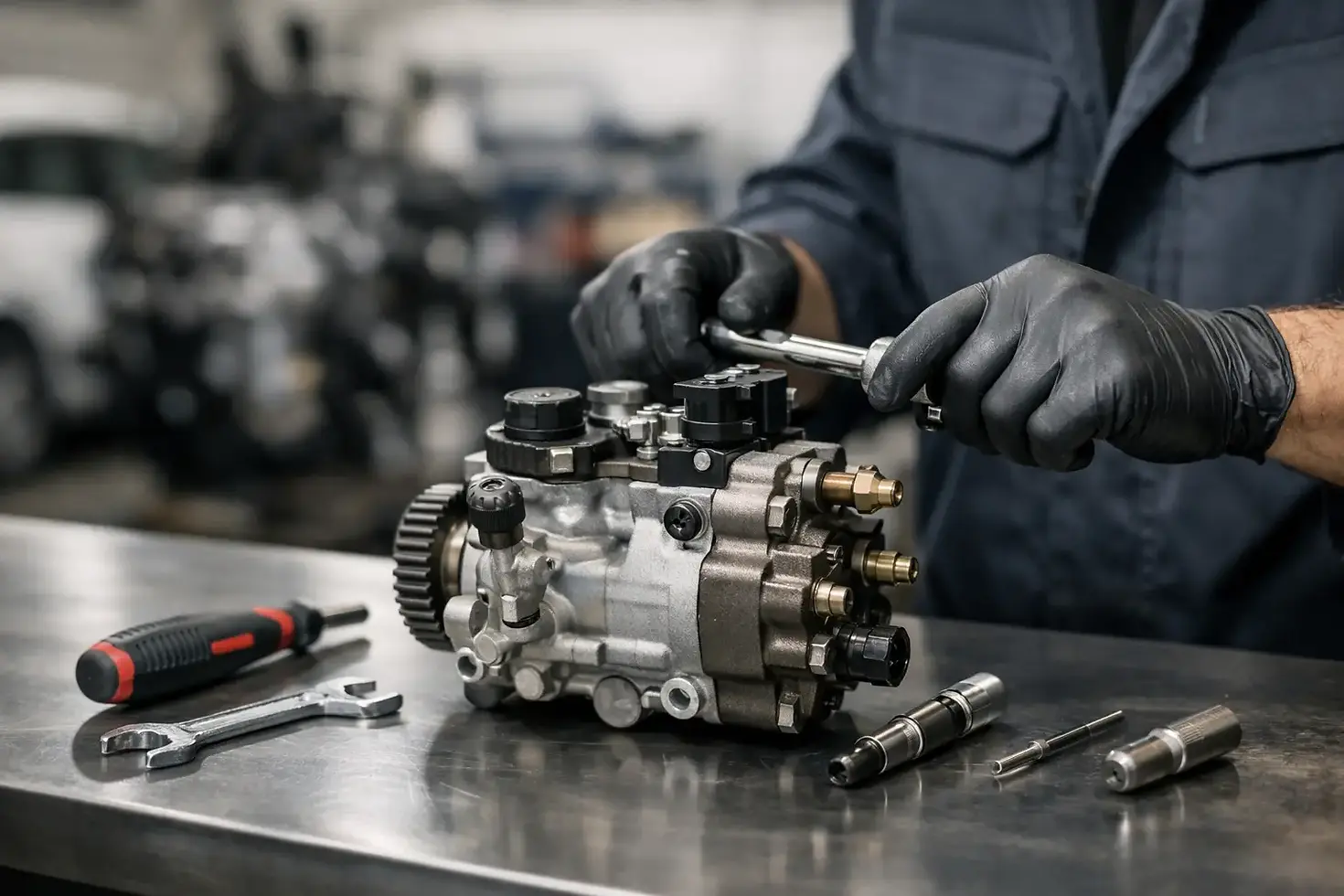
Proper fuel injection pump repair usually starts with diagnosis on the vehicle or machine, then moves to controlled bench testing once the unit is removed. The pump is disassembled, cleaned, inspected for wear or contamination, measured against specification, and repaired or rebuilt using the correct parts. After reassembly, it must be calibrated and tested again to verify output, timing behavior, pressure performance, and overall function.
This is the point where the difference between a specialist shop and a general repair attempt becomes obvious. You are not just replacing seals and hoping for the best. You are restoring a precision component that directly affects combustion quality and engine life.
Repair, rebuild, or replace - what makes sense?
It depends on the pump design, the failure mode, and the condition of the rest of the fuel system. Some pumps respond well to targeted repair when the issue is isolated to seals, wear items, or a specific control component. Others are better handled as a full rebuild, especially when contamination, internal scoring, or age-related wear has affected multiple internal parts.
Replacement is sometimes necessary, but not always the smartest first move. A new unit may be expensive, hard to source, or unavailable for older applications. In many cases, a properly rebuilt and calibrated pump is the more practical option, especially for heavy-duty, agricultural, marine, and industrial equipment where component support and turnaround time matter.
The key is knowing what failed and why. If contaminated fuel caused the damage, installing another pump without cleaning the tank, lines, filters, and related components invites the same failure again. If timing issues were created by installation error or related engine problems, the pump may not be the root cause at all.
Fuel injection pump repair and system contamination
Contamination is one of the biggest reasons pumps fail before their expected service life. Water, poor fuel quality, microbial growth in storage systems, rust, and fine abrasive material can all damage internal surfaces. High-pressure systems are especially unforgiving. Once metal starts circulating through the system, injectors, rails, lines, and regulators may all be affected.
This is why competent repair work has to look beyond the pump housing. The fuel supply side needs to be checked for restrictions, aeration, and debris. Filters and housings need inspection. Tanks may need cleaning. Lines may need replacement or flushing depending on the failure. On some jobs, the pump is only one part of a larger corrective process.
Skipping that wider inspection is one of the fastest ways to turn a repair into a comeback. In a proper diesel workshop environment, diagnosis is tied to the full system, not just the part on the bench.
What to expect from a professional repair process
A serious repair facility will start by confirming the complaint and identifying the exact pump and application. That matters because calibration values and service procedures vary by engine family, pump model, and intended use. A marine engine, a highway truck, and a piece of agricultural equipment may all use diesel fuel injection, but they do not live under the same operating conditions.
Once the pump is removed, the unit should be inspected for external damage, leaks, shaft play, evidence of contamination, and prior repair history. Internal inspection then determines whether the pump is suitable for repair, requires a full rebuild, or should be replaced. Components are cleaned, measured, and matched to specification. Wear parts and damaged internals are replaced with quality components, not generic shortcuts.
Calibration is the part many customers never see, but it is one of the most important steps. Output volume, pressure characteristics, governor behavior, timing advance where applicable, and overall operating balance need to be verified on proper equipment. Without that step, the job is unfinished.
Shops with in-house test and calibration capability offer a real advantage here. West Coast Fuel Injection & Turbo Ltd., for example, works with diesel pumps, injectors, and related components across a wide range of applications, which matters when a repair needs both component precision and full-system understanding.
When pump problems are really installation or support issues
Not every pump complaint comes from internal pump failure. Air leaks on the supply side, incorrect timing during installation, wiring faults on electronically controlled systems, restricted filters, weak lift pumps, and poor-quality replacement parts can all create symptoms that look pump-related.
That is why installation support and post-repair checks matter. A correctly repaired pump can still perform badly if the engine timing is off, the fuel supply is unstable, or contaminated lines are left in service. This is also where experience across Cummins, Caterpillar, Volvo, Bosch, Denso, Stanadyne, and other major systems pays off. Different platforms fail differently, and the test plan should reflect that.
For working equipment, the goal is not just to get the engine started again. The goal is to restore predictable performance, protect injectors and other expensive components, and reduce the chance of repeat downtime.
Choosing a shop for fuel injection pump repair
The right shop should be able to explain how it diagnoses the problem, what testing is performed, whether calibration is done in-house, and how it handles contamination-related failures. If the answer is limited to replacing parts until the symptom changes, that is not a fuel system strategy.
Look for a specialist with a fuel lab or workshop setup, access to proper test equipment, experience across multiple diesel platforms, and the ability to support related components such as injectors, turbochargers, and supply-side hardware. That broader capability matters because pumps do not fail in isolation very often.
If your truck, vessel, tractor, generator, or industrial unit is showing the classic signs of pump trouble, early diagnosis usually saves money. The longer a failing pump is left in service, the greater the chance of contamination, injector damage, poor combustion, and avoidable downtime. A good repair does more than restore fuel delivery - it puts the engine back on dependable footing for the work ahead.
Comments