
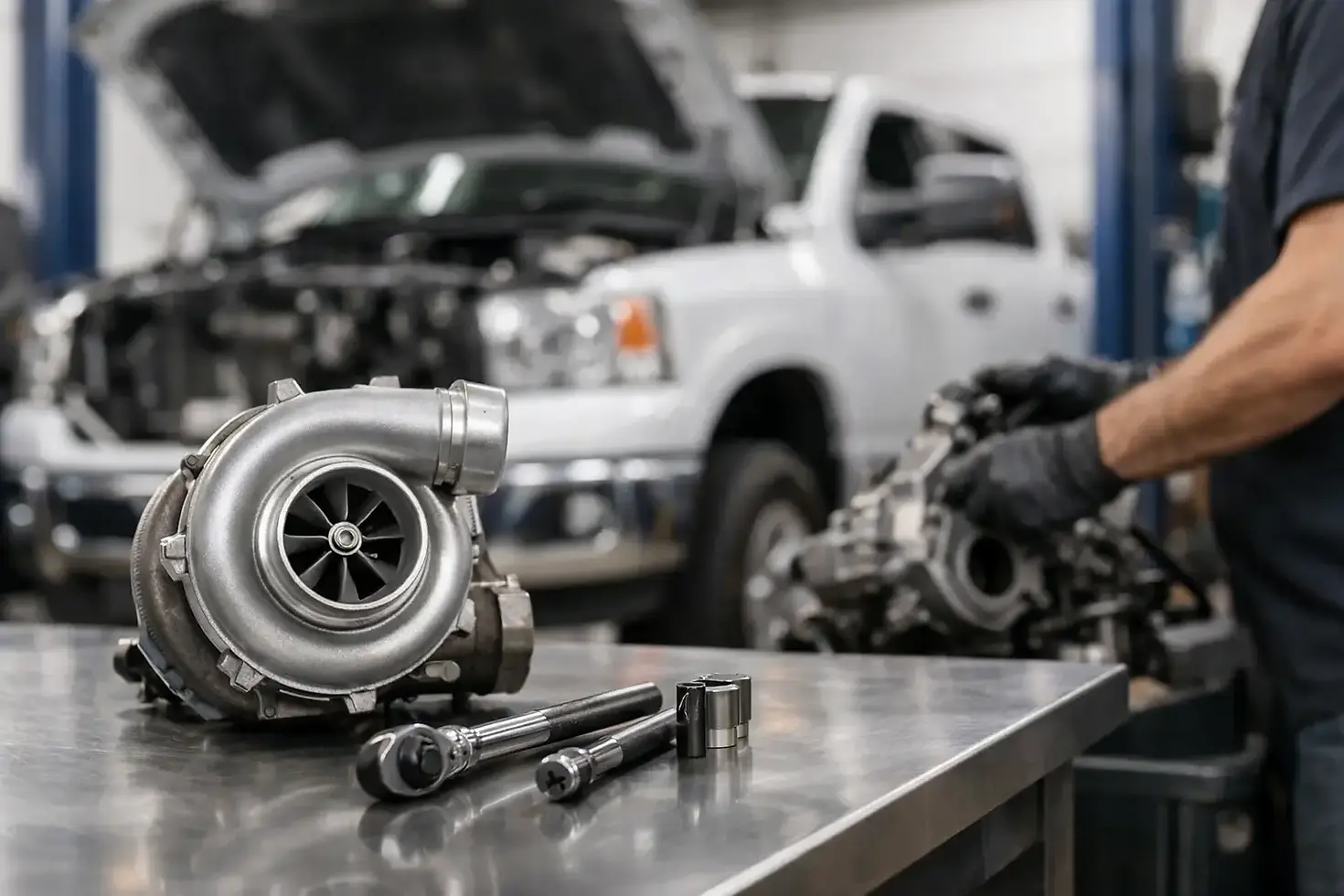
Light Duty Diesel Turbo Service Basics
- Jun 15
- 6 min read
A light-duty diesel rarely gives you much warning before turbo trouble starts costing money. One week the truck feels a little lazy on grade, then fuel economy slips, boost response gets inconsistent, and suddenly you are dealing with smoke, noise, or limp mode. That is where proper light duty diesel turbo service matters - not just swapping parts, but identifying why the turbo system is no longer working as a matched part of the engine.
On modern diesel pickups and light commercial platforms, the turbocharger is tied directly to drivability, emissions performance, exhaust temperature control, and engine protection. When boost is wrong, the problem often reaches beyond the turbo itself. A vehicle may come in with low power and excessive black smoke, but the root cause could involve vane sticking, oil contamination, charge air leaks, actuator faults, fueling imbalance, or restriction elsewhere in the system. Treating every complaint as a simple turbo replacement is expensive and often wrong.
What light duty diesel turbo service actually includes
A proper service process starts with inspection and testing, not assumptions. On a light-duty diesel application, that means evaluating the turbocharger assembly, boost control system, air path, oil supply and drain condition, and supporting engine data. If the unit is variable geometry, the vane pack and actuator behavior need to be checked carefully because many driveability complaints come from control issues rather than catastrophic wheel damage.
In workshop terms, service can include removal and teardown, cleaning of carbon-related deposits, measurement of shaft play and housing condition, inspection of compressor and turbine wheels, actuator testing, balancing verification where applicable, rebuild or remanufacture decisions, and installation support. It may also include checking injectors or fuel delivery if combustion problems are contributing to abnormal exhaust heat or soot loading.
That broader view is important on engines from Cummins, Duramax, Power Stroke, and other light-duty diesel platforms. Turbocharger failure is sometimes the final symptom, not the first cause.
Why diagnosis matters more than replacing parts
A turbocharger lives in a difficult environment. It depends on clean oil, stable exhaust flow, proper air filtration, and accurate control inputs. If one of those conditions is off, a replacement turbo can fail early for the same reason the first one did.
For example, a unit with oil leakage may not actually have failed from wear alone. Restricted oil drain flow, excessive crankcase pressure, or poor-quality oil can produce similar evidence. A truck with overboost codes may have a sticking vane mechanism, a faulty actuator, incorrect sensor feedback, or a charge air control issue. A whistle under load might point to compressor damage, but it can also come from an intake or intercooler leak.
That is why light duty diesel turbo service should include a full look at the operating conditions around the turbo. A good shop isolates whether the issue is mechanical, control-related, lubrication-related, or tied to fueling and combustion. That distinction affects repair cost, downtime, and long-term reliability.
Common signs the turbo system needs attention
Most operators notice performance before they notice a specific component problem. Low power under load, slow spool-up, increased exhaust smoke, check engine lights, poor fuel economy, and abnormal turbo noise are common starting points. Some vehicles also show repeated regeneration issues or elevated exhaust temperatures because airflow and boost are no longer being managed correctly.
Not every symptom means the turbocharger itself is beyond repair. Carbon buildup in a variable geometry unit can cause vane sticking. An electronic actuator may lose range or fail calibration. Compressor wheel damage may be localized enough that the center housing and other major components remain serviceable. On the other hand, if wheel contact has damaged housings or bearing failure has sent debris through the system, replacement or full remanufacture may be the only sound option.
The difference comes down to inspection, measurement, and test results.
Light duty diesel turbo service for VGT and conventional turbos
Many newer light-duty diesels use variable geometry turbochargers because they improve low-speed response and help support emissions strategy. These units offer better control, but they also introduce more failure points. Soot accumulation, heat cycling, and actuator faults can all affect vane movement and boost control.
Servicing a VGT is not the same as servicing a simpler fixed-geometry turbo. The unison ring, vane assembly, nozzle area, and actuator calibration all matter. Cleaning without proper disassembly and inspection can leave hidden wear behind. Replacing an actuator without confirming vane movement can also lead to repeat failure.
Conventional turbos are mechanically simpler, but they still require careful evaluation of bearing condition, seals, wheel integrity, and housing wear. In both designs, balance and assembly standards matter. Small deviations at turbocharger speeds become major problems quickly.
Why the fuel system and turbo system often need to be checked together
Diesel performance problems do not stay isolated for long. Overfueling, poor injector spray pattern, timing issues, or pump-related irregularities can raise soot output and exhaust temperatures, which puts extra load on the turbocharger. The reverse is also true. Poor boost can create incomplete combustion, smoke, and sluggish response that look like fueling problems at first glance.
That is why a one-shop diagnostic approach has real value. If a vehicle needs turbo inspection and injector or fuel system testing at the same time, the repair path becomes clearer. Instead of changing one expensive component and hoping the complaint disappears, the technician can verify how air and fuel are interacting under the same operating problem.
For working trucks, that approach cuts down on repeat visits. It also protects against installing good parts into a bad system.
Repair, rebuild, or remanufacture - what makes sense?
There is no single answer for every turbocharger. In some cases, a targeted repair is enough. If the issue is carbon-related vane restriction, actuator malfunction, or a serviceable wear condition caught early, the turbo may be restorable without replacing the entire assembly.
A rebuild makes sense when the major hard parts remain usable and the internal wear components can be replaced to spec. This route can be cost-effective, but only if the inspection standards are strict and the rebuilder has the equipment and technical process to do the work correctly.
Remanufacturing is often the better option when the goal is dependable return-to-service with verified component condition and calibration standards. It is especially relevant for commercial users who care more about uptime and repeatability than about the cheapest invoice. The right decision depends on housing condition, wheel damage, shaft wear, actuator status, parts availability, and the intended duty cycle of the vehicle.
A technical shop should be clear about those trade-offs instead of pushing the same answer every time.
Choosing a shop for light duty diesel turbo service
Turbo work on diesel pickups and light commercial vehicles is specialized work. The right shop should understand OEM-specific failure patterns, have access to proper test and inspection procedures, and be equipped to evaluate related systems when needed. That includes not only the turbocharger itself, but also oiling condition, charge air plumbing, actuator operation, and fuel system behavior.
Brand familiarity matters. A shop that regularly handles components tied to Bosch, Denso, Stanadyne, Cummins, Caterpillar, and Volvo-supported applications will usually have a stronger diagnostic process than a general repair facility that mainly installs replacement parts. Experience with calibration, remanufacturing standards, and component-level repair is especially important when the goal is reliable service rather than short-term patchwork.
West Coast Fuel Injection & Turbo Ltd. works from that specialist model, which is why customers dealing with turbocharger and diesel fuel system issues often need more than a counter sale. They need technical diagnosis, workshop capability, and a repair path built around the actual cause of failure.
Preventing the next turbo problem
Most repeat turbo failures can be traced back to something that was missed. Oil contamination, restricted drains, poor warm-up and shutdown habits under heavy load, leaking charge air boots, intake restriction, and unresolved fueling problems all shorten turbo life.
Preventive service is not complicated, but it does need discipline. Keep up with oil and filter intervals using the correct specification. Address boost leaks early. Pay attention to smoke changes and new noises. If the vehicle has a history of injector or fuel delivery problems, do not assume a fresh turbo alone will restore proper operation.
The best results come from treating the turbocharger as part of a complete diesel air-and-fuel system. When service is handled that way, you get more than restored boost. You get a vehicle that responds properly, runs cleaner, and stays in service longer.
If your truck is showing early signs of turbo trouble, the smartest move is to test it before a drivability complaint becomes a hard failure.
Comments