
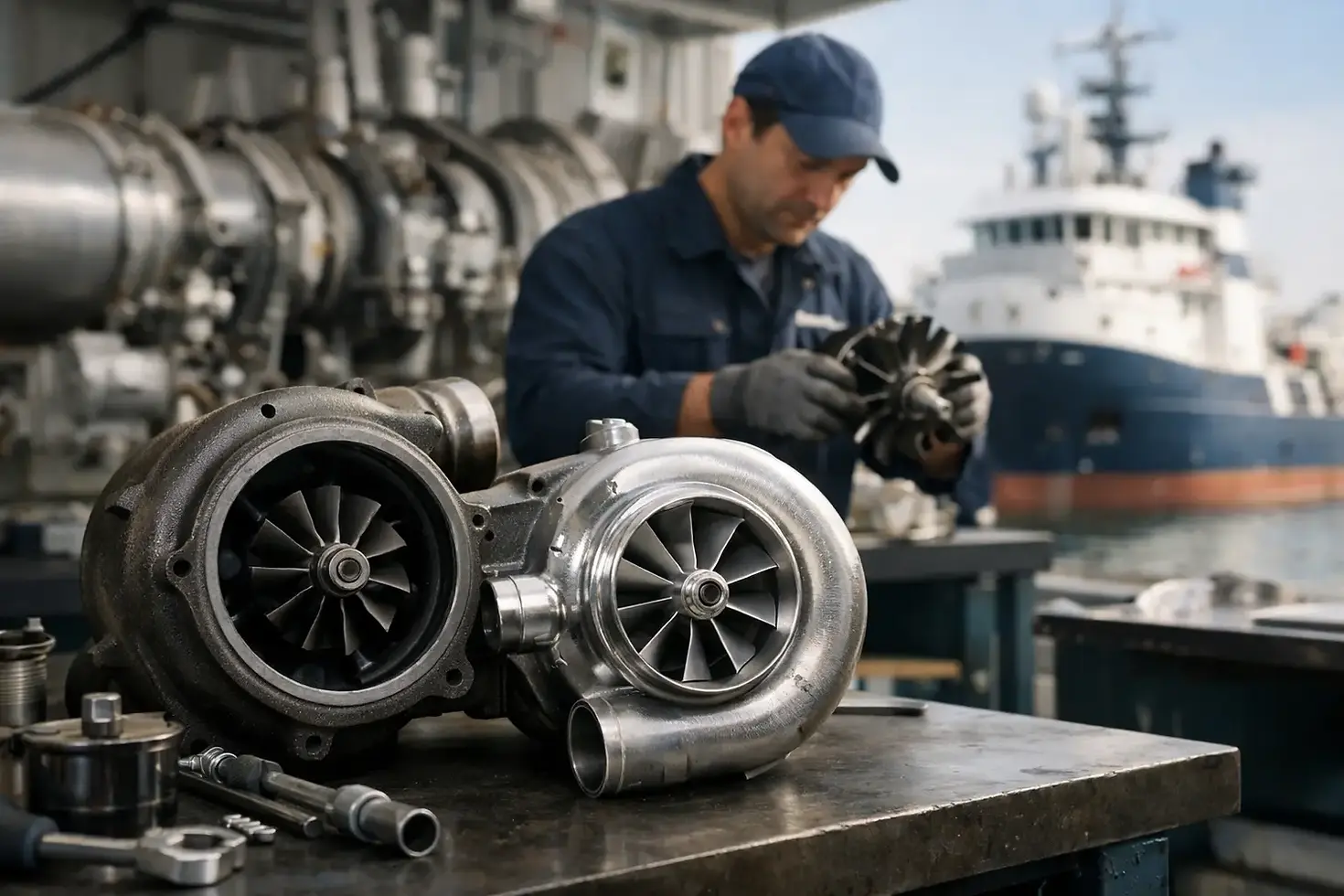
Marine Turbo Repair and Rebuild Basics
- Jul 6
- 6 min read
A marine engine that starts smoking under load, falls off on boost, or struggles to reach rated RPM is usually telling you something early. In marine turbos repair rebuild work, catching that message before a hard failure matters, because turbo damage rarely stays isolated for long. Once a wheel contacts the housing, a bearing fails, or oil contamination gets into the center section, the risk moves quickly from lost performance to broader engine damage and lost operating time.
Marine turbochargers live in a hard environment. Salt exposure, long running hours, variable load, heat cycling, and maintenance gaps all work against bearing life, sealing, and turbine efficiency. On a workboat, fishing vessel, patrol unit, or private diesel-powered cruiser, the turbo is not a minor accessory. It is a core air-handling component that directly affects combustion quality, fuel consumption, exhaust condition, and engine response.
When marine turbo repair and rebuild is the right call
Not every turbo problem means the unit should be replaced, and not every turbo should be rebuilt just because it can be. The right decision depends on the failure mode, the condition of the housings and rotating assembly, parts availability, and the application.
A proper repair or rebuild makes sense when the main structure of the turbo remains serviceable and the unit can be restored to specification with quality parts, accurate machining, and correct balancing. This is often the better route when an operator wants to retain an OEM-fit unit, control cost, and get back a tested component rather than taking chances on an unknown replacement.
There are also cases where replacement is the smarter option. If the turbine housing is heavily cracked, the compressor or turbine wheel is catastrophically damaged, or corrosion has compromised critical surfaces, rebuilding may not be cost-effective. The same applies when the root cause is not just internal wear but external engine issues that have already created repeat damage. A turbo should never be rebuilt in isolation if the actual problem is poor lubrication, debris ingestion, restricted oil drain, overfueling, or excessive exhaust temperature.
Common signs a marine turbo needs attention
Most marine turbo failures do not happen without warning. Operators and mechanics usually see a pattern first. The engine may feel lazy off idle or slow to build power. Smoke may increase under acceleration or at cruise. Oil consumption may rise. In some cases, there is a clear whistle change, scraping noise, or evidence of oil at the compressor outlet.
Soot buildup, wet exhaust signs, and reduced top-end RPM also point toward air delivery problems. That does not automatically confirm the turbo is the only fault, but it does justify inspection. On marine applications, delayed response can be expensive. Continued operation with a failing turbo can send fragments into the intake or exhaust side, contaminate the charge air system, and drive up engine temperature.
A careful diagnosis matters because several symptoms overlap with injector, fuel pump, air restriction, and exhaust restriction issues. This is where a specialized diesel shop approach is worth more than a parts-counter guess. Turbo condition should be evaluated alongside fuel delivery, engine breathing, oil supply, and operating history.
What a proper marine turbo rebuild actually includes
A true rebuild is more than a seal kit and a quick cleanup. On a marine turbocharger, the process should begin with full disassembly and detailed inspection of the compressor housing, turbine housing, center housing rotating assembly, shaft, wheels, bearings, seals, thrust components, and wastegate or variable control hardware where applicable.
The next step is identifying why the turbo failed. If there is shaft scoring, thrust wear, carbon packing, corrosion, wheel impact, or heat stress, those findings need to be tied back to engine conditions. Rebuilding without root-cause diagnosis is one of the main reasons operators end up with repeat failures.
After inspection, serviceable hard parts are cleaned and measured. Wear surfaces are checked against specification. Parts that do not meet standard are replaced, not reused on hope. The rotating assembly must then be rebuilt with quality components and balanced correctly. That balancing step is not optional. A marine turbo operates at extremely high shaft speeds, and even small imbalance issues shorten bearing life fast.
Final assembly should be followed by testing and verification. Depending on the turbo design, that may include actuator checks, wastegate setup, flow-related verification, and confirmation that the assembled unit meets expected operating parameters. A rebuilt turbo that has not been properly measured and balanced is simply a cleaned turbo with fresh parts.
Marine conditions make turbo service different
Marine applications put special demands on turbochargers compared with many on-road systems. Engines may run for long periods at steady load, and service intervals can stretch if the vessel operates hard during peak season. Moisture, salt, and storage conditions also create corrosion risks that are less common in controlled land-based environments.
This matters during both inspection and rebuild. A marine unit may show external corrosion that looks minor but affects fasteners, housings, clamp surfaces, or actuator movement. It may also have carbon and heat buildup linked to prolonged idle, low-load operation, or fuel system imbalance. In twin-engine setups, comparing boost behavior and exhaust condition side to side can reveal problems earlier than a single-engine operator might catch.
The marine environment also raises the cost of downtime. An owner-operator can sometimes schedule truck repairs around route demand. On the water, the same issue can shut down a charter, delay commercial work, or create a safety problem if power is limited where it should not be.
Why diagnosis matters as much as the rebuild
A turbocharger is often blamed for symptoms that started somewhere else. Contaminated oil, delayed oil pressure, blocked drains, air filter failures, exhaust leaks, injector imbalance, and overfueling can all damage a rebuilt unit if they are left unresolved. That is why the best marine turbos repair rebuild work is tied to full diesel system awareness, not just bench work.
If a compressor wheel has ingested foreign material, the intake path and charge air cooler need inspection. If the turbine side shows extreme heat, fuel delivery and exhaust flow need attention. If there is heavy oiling, crankcase ventilation and oil return restrictions should be checked before a rebuilt turbo goes back on the engine.
This broader diagnostic approach is where experienced diesel service shops separate themselves. West Coast Fuel Injection & Turbo Ltd. works across turbochargers, injectors, pumps, calibration, and system-level diesel diagnostics, which is exactly the kind of support marine operators need when the problem is not confined to one part.
Repair, rebuild, or remanufacture - knowing the difference
These terms are often used interchangeably, but they are not always the same in practice. A repair may involve correcting a specific issue while retaining more of the original internal parts. A rebuild usually means replacing normal wear components and restoring the unit to working condition after inspection and balancing. Remanufacturing typically goes further, with tighter restoration standards, more extensive replacement of critical parts, and process controls intended to return the turbo closer to OEM-level specification.
For the customer, the right choice depends on operating demands. A lightly used private vessel may be well served by a properly executed rebuild if the hard parts are sound. A commercial marine operator running long hours may want a higher-level remanufactured solution, especially where uptime and reliability matter more than the lowest initial invoice.
What to ask before approving a marine turbo rebuild
The right shop should be able to explain what failed, what will be replaced, how the rotating assembly will be balanced, and whether supporting engine checks are recommended. If those answers are vague, the work probably is too.
It is also fair to ask about parts quality and brand familiarity. Marine diesel fleets run a wide range of OEMs and turbo platforms, and service quality improves when the shop is already familiar with the design, application, and failure patterns. Shops that also work with injectors, fuel pumps, and calibration tend to catch linked problems sooner because they are not looking at the turbo in a vacuum.
Turnaround time matters, but speed should not come at the expense of inspection and testing. Fast service is useful only if the turbo comes back right the first time.
Getting longer life from a rebuilt marine turbo
A rebuilt turbo will only last if the installation and follow-up checks are done properly. Oil feed and drain lines should be clean and unrestricted. The intake and charge air path should be free of debris. Mounting surfaces, clamps, and gaskets should be checked carefully. Priming procedures matter, especially on fresh installs where dry start-up can damage new bearings immediately.
After startup, oil leaks, boost response, exhaust condition, and operating temperature should be monitored closely. If the original failure was caused by fuel or air imbalance, that issue needs to be corrected at the same time. Good rebuild work is only half the job. The rest is making sure the engine environment is fit for the turbo going back on it.
For marine operators, the practical goal is simple. You want a turbocharger that is inspected properly, rebuilt to specification when rebuilding is the right option, and supported by diesel diagnostics that address the whole system. That approach costs less than repeat failures and gives you something more valuable than a quick fix - confidence when the engine is under load and the vessel needs to perform.
Comments